
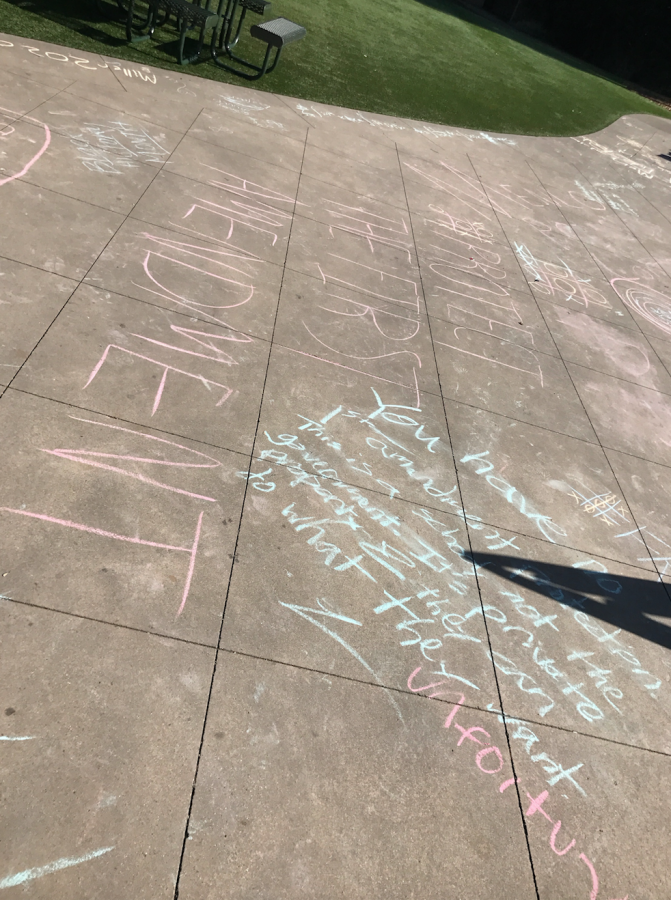
The Menlo Happiness Club’s Valentine Day chalk activity was designed for students to express their gratitude for what they love, but many students used this platform to write controversial messages about problems they have with the school or other comments. Staff photo: Abby Wolfenden.
By Abby Wolfenden
On Feb. 14, a series of controversial messages were written by a small group of Menlo upperclassmen in chalk on the quad during tutorial and lunchtime. What was supposed to be a celebration of Valentine’s Day turned into a school-wide controversy.
The chalk drawing activity was initiated by the Happiness Club, and according to the club leaders, it was intended for students to write about what they love. While many students took the opportunity to write kind, encouraging messages and drawings, there were others who chose to write a variety of slogans and messages that were deemed offensive, crude, or inappropriate by the administration, teachers, and student council alike.
Such messages included “Menlo preaches communism,” “Real men eat ass,” and “Sister Spit preaches obesity” among others. The comment about Sister Spit was seen as especially problematic to student council, since they were a group of poets who had been invited to speak at a Menlo assembly this past Tuesday. These messages not only caused discomfort and shock amongst many students, but also within the administration, faculty, and student council. “It was mostly sad for me to see that students were being that disrespectful with their language,” said Dean of Student Life Programs Cathy Chen. “I was really shocked and surprised. I’ve been at Menlo for 10 years and I’ve never seen anything like that.”
Chen doesn’t believe that the intent of the students was to ruin Valentine’s Day but rather that they saw it as an opportunity to express their ideas, even if some of those ideas were derogatory. Chen doesn’t believe the activity itself to have been the issue. “I don’t think not having chalk is going to solve the deeper issue of disrespect. The disrespect isn’t just about what those students wrote on the quad, [but] you see it in other places in the school. Today was just another example of that,” Chen said.
The activity took place before school, during tutorial, and during lunch on Wednesday Feb. 14. It began like any other chalk event that Menlo has held in the past, but gradually escalated as the day progressed. “Happiness [club] has done this activity pretty regularly, and it’s just to spread joy [and] for people to express themselves, and I think we’ve had it without hitch all four years I’ve been at Menlo,” senior Sarah Donato said. “It’s been very successful and a very welcomed activity. It’s really sad that someone kind of messed with it, and they tried to […] say something funny in a way that ended up just ruining a fun activity for everyone.”
One of the Happiness Club leaders, senior Ellie Kunwar, explained that the event’s intention was to be an outlet for celebration and happiness. “[…]We thought it would be nice for people to write what they loved and just have fun playing with chalk. We didn’t really expect people to write those sorts of things– the intent was good, and we just thought it would be a fun idea [for a] lunchtime activity,” Kunwar said. “I thought most people’s messages and drawings were nice and people were having fun with the activity; however, there were some messages that I thought were inappropriate and immature.”
Student Council Secretary-Treasurer Keeton Martin also found some of the messages to be disrespectful. “People wrote some really hateful things,” Martin said. “One message in particular was very hateful. Also there were some inappropriate things which were probably less egregious, but it just depended message to message.”
Some students were upset by how the administration handled the situation, since several students were brought in for questioning. “I got called into Mr. Lapolla’s office during break on [Feb. 15] and when I walked in there, he basically accused me of writing the ‘Sister spit promotes obesity’ comment in chalk, and that’s actually not true,” senior David Quezada said. He explained further that once he told Lapolla what happened they were able to have a dialogue about it and take action. He openly discussed how he wrote the “Menlo preaches communism” comment, and as a student council member, he helped to erase the comment even though he didn’t believe in erasing it. “Once [Mr. Lapolla] heard [that I didn’t write the sister spit comment] we changed the conversation to if I had the right [to write the communism comment] and what may have been wrong or offensive about what I wrote,” Quezada said. “We actually had a pretty productive conversation where we talked about students’ rights, and eventually we came to the conclusion that writing ‘Menlo preaches communism’ [shouldn’t need to be erased].”
While students who were brought in for questioning were defensive about the situation, Lapolla explained that it wasn’t at all an accusation against students, but simply a way to collect information. “Falsely accused is an inaccurate statement. Whenever you are trying to gather information, you talk to people. I think it’s a gross exaggeration to say anyone was accused of anything. That’s not my style. […] I don’t accuse people of things that they don’t take ownership for. In fact there was really only one student that I’ve taken any action on and it was a student that did write the profanity,” Lapolla said. “We always should be able to talk to each other. I think that my practice is always that any action I take is going to be fair and the action is directly connected to whatever the incident is. I do believe in talking [and] I do believe in talking to a variety of people because that’s the only way I’m going to get a sense of what is happening.”
Students such as Quezada expressed their frustration with bystanders who may have falsely reported things to Lapolla. “I was pretty angry about [being questioned for writing the sister spit comment] because it just seems like whoever is accusing certain people of writing things on the ground is not actually taking the time to make sure that their claims are accurate,” Quezada said. “In my opinion, it’s a pretty serious thing to accuse someone of writing something on the ground that could be interpreted as offensive. […] You should probably have seen it [happen] if you’re going to accuse someone, instead of listening to rumors and reporting every rumor to Mr. Lapolla.”
Student council decided to respond to the incident by sending an email on Feb. 15 at 4:20 pm to the entire student body. In the email, they advocated for students to take action when seeing their peers engaging in inappropriate or demeaning activities. They also relayed how the content of the messages was unkind and disrespectful to many members of the Menlo community. “We encourage critical voices but we expect them to be constructive and civil,” the email said. “Menlo is a community we are all lucky enough to be members of, so let’s all do our part to respect our values.”
Chen had hoped student council would address the issue like this, and she agreed with the sentiments in the email. “I think I’m at a little bit of a loss. But, I am hoping that student council will take this on. I hope the student body will take it on, and not just student council, but I hope that any student who feels like a leader in this school will feel like this is an issue that they can help address,” Chen said on Feb. 14.
After a group of students was told to erase one of the messages, other students wrote “Protect the First Amendment” and “Censorship kills creativity,” which were countered by a statement claiming Menlo students had no rights at a private institution. Upper School Director John Schafer dispelled this assertion. “There are free speech rights for students at Menlo,” Schafer said. However, Schafer does not believe free speech to be the root of the problem. “It’s not so much a free speech issue, because yes, people have the right to speak freely and to have their views, but it seems to be disrespectful to the Happiness Club who launched the event and left the chalk. It seems to me that [it] wasn’t the appropriate time or venue to make a larger point about the school,” Schafer said. “I’d make a distinction between speech and sloganeering. […] I don’t think there was any dialogue […] it was sort of conversation by graffiti […] So, I’d make the distinction: Could someone write something on the bathroom walls and say ‘Free Speech’? I suppose one could make that argument, but it’s not the culture of the school. We’re not going to enable that or turn a blind eye to that.”
It is important to note that the majority of students were not involved with the series of unkind messages written on the quad, and student council and the administration recognize this. “It’s not the majority of the school,” Chen said. “I think it’s a small subset. The issue is that people are trying to express disappointment or unhappiness with the school, and then the way they chose to do it was in an upsetting, disrespectful, careless, thoughtless sort of way.”
Kunwar also expressed that the majority of the student body was not involved, and many of the participants wrote positive messages. “While I do think some of the messages were inappropriate, I think the situation was blown a little out of proportion. I think it all could’ve been handled a little better both on the administrative and student body side,” Kunwar said.