
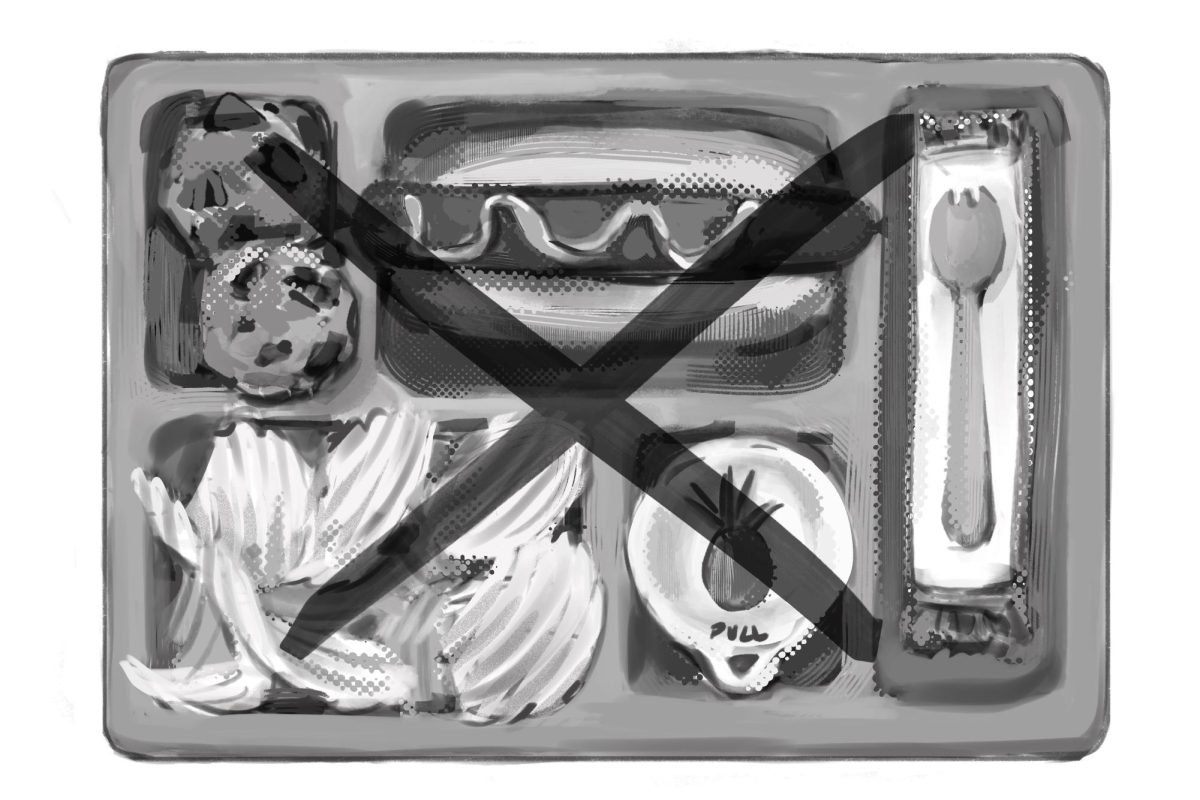
This past October, California Gov. Gavin Newsom signed the Real Food, Healthy Kids Act aimed at eliminating ultra-processed foods (UPFs) from school cafeterias. In a country where two-thirds of teenagers get their calories from overprocessed foods, California has become the first state to make strides toward banning UPFs altogether.
The California Department of Public Health (CDPH) will have until 2028 to determine exactly what foods will be banned. They are expected to target foods containing heavily processed additives, such as saturated fats or artificial sweeteners, including hot dogs, certain cereals and even flavored yogurt. Once the CDPH has picked out the foods they want out of cafeterias, public schools in California will have until 2035 to stop distributing those items on school campuses statewide.
The impact of this policy will be apparent almost immediately at Menlo, according to Head of Dining Services Thien Hoang. He specified that Flik School Dining is already opting to start phasing out certain foods from the snack shack and from the daily lineup of meals served to students.
Hoang said that Flik already limits its use of UPFs, so the transition to more organic food alternatives should take less time at Menlo. Flik will be experimenting with ways to supplement foods that are currently classified as being overprocessed, such as cereals and certain meat products. “The policy that Flik is trying to institute is when we take away a product that has processed food, we have to find a comfortable replacement for it,” Hoang said.
One of the suppliers for Flik’s ingredients is Menlo’s own Gardening Club, led by juniors Lauren Rukavina and Murohn Zhang. According to Rukavina, Menlo’s dining staff frequently uses carrots, radish and bok choy, among other foods, to incorporate into their salad bar.
“As a gardener, I recognize how much more expensive and tedious it is to source [organic food], but I think it’s important to prioritize […] healthy and fresh food. [It] is crucial for energy and well-being, which every kid deserves,” Rukavina said.
Hoang acknowledges that distributing organic food is more costly for Flik, but he believes Menlo’s dining program is better off spending more on healthier organic products than using cheaper foods. “You know, for us, it’s actually a little bit [more] expensive […] [taking food] from farm to table,” Hoang said. “[But it’s] the philosophy of Flik. We try to get products that are sustainable [and] products that are local, so that it cuts down on [our] carbon footprint.”
While freshman Lily Gazor is disheartened to see that certain cafeteria foods will be filtered out of rotation, she recognizes that their organic alternatives are important to integrate into Menlo’s cafeteria. “I think it’s also fun having some foods like chips and yogurt, which can [taste] good for students. So I guess I’m kind of in between,” Gazor said. “I think that there should be a balance, because it’s important to have healthier and sustainable foods.”
According to The New York Times, chemical additives in UPFs often take away from their flavor in favor of preserving them for as long as possible. As a result, aside from being healthier, organic foods also have more flavor due to their fresh ingredients. “All the things that they put in [ultraprocessed foods] to keep it fresh and keep the shelf stable are the things that [take away] from a lot more flavor,” Hoang said. “By using organic [foods] […] you’re actually getting a better product.”