
Influenza A, an unprecedented mutant of the seasonal flu, swept into crowded classrooms when students returned from holiday break. More students and staff are calling in sick, while others push themselves to show up with aching throats, runny noses and fevers. The Menlo Health Office reported 65 cases and counting of Influenza A by late January, urging the community to maintain proper hygiene as numbers continue to rise nationwide.
Although the current vaccine reduces the probability of serious hospitalization, it only offers minimal protection against this mutant on a day-to-day basis. Every February, the World Health Organization predicts possible flu variants in the Northern Hemisphere and creates vaccines based on their research. According to the Centers for Disease Control and Prevention (CDC), this year’s vaccines targeted three prominent virus strains: two Influenza A strains (H1N1 and H3N2) and one Influenza B strain (B/Victoria lineage). However, Subclade K, a previously dormant mutant of Influenza A H3N2, has resurfaced.
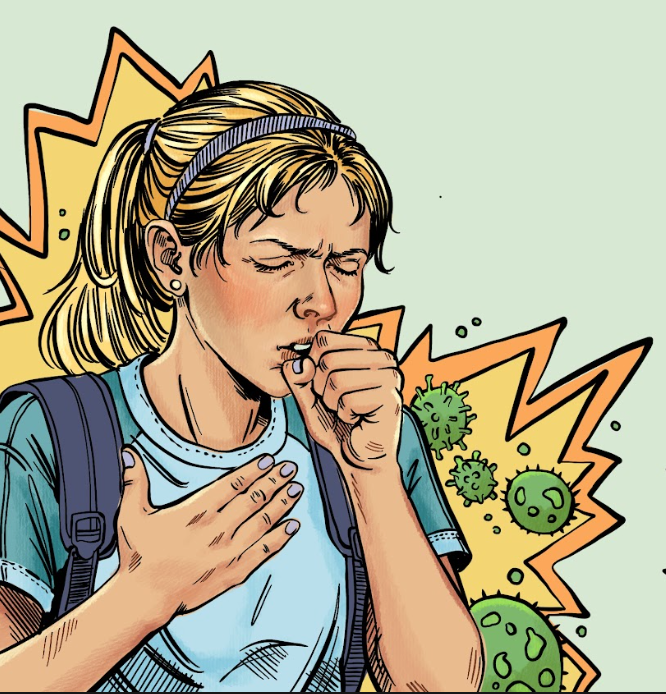
Sophomore Caitlin Wong received a flu shot in late September but caught Influenza A as soon as she came back from holiday break. “I felt like death,” she said. “It sucks because it’s hard to fully rest when you know how much work is waiting for you.” Despite her sore throat and lingering cough, Wong stayed in school to avoid falling behind, noting that risking even one day of class could lead to multiple nights of homework. “This is definitely a universal problem,” she added. “People are worried whenever someone next to them coughs or sneezes.”
Upper School Administrative Assistant Jocelyn Rodriguez believes that students should find a healthy balance between motivation and rest. “If you don’t take the day off, you only prolong the sickness and risk spreading it to others who are perfectly fine,” she said. Rodriguez also observed an increase in students only attending school for half of the day, a pattern she hopes they will reconsider.
On the other hand, English teacher Jay Bush argues that missing class only adds pressure to his already-tight schedule. “The worst part about getting sick as a teacher is that you feel a strong responsibility for your students,” he said. “And if you’re not there, then one of your colleagues, all of whom are completely booked and exhausted and working as hard as they possibly can, is going to have to cover for you.”
Bush caught the flu three separate times between November and January, missing two days in a row of classes for the first time since he joined Menlo in 2019. As a result, he had to grade over 100 written assignments — around 40 hours of work — from his sophomore and senior classes.
For teams that rely entirely on participation, last-minute fevers and chills can undermine months of preparation. Mock Trial faculty advisor Joseph Mitchell says that missing key members hurts the team’s performance in court. “Usually, they just take a lot of cold and flu meds, but it doesn’t work out as well,” Mitchell said. In hopes that the teams’ hard work will pay off in future county and state competitions, he constantly reminds his students, “don’t get sick.”
Winter sports teams have also experienced an uptick in cases following holiday break, a challenge that Boys Varsity Soccer Coach Daniel Hicker says is always difficult. “We try to maneuver through these weeks, because now we’re in the 2nd half of our season,” Hicker said. “We want everybody to be as healthy as they can.”
With practices and competitions six days a week, Athletic Trainer Stephanie Green warns that students in sports are especially prone to spreading airborne viruses like the flu. “If someone on the soccer team gets sick, we suspect there’s probably going to be a few more kids on the soccer team that are going to get sick just because they’re in close proximity for so long,” Green said. In an attempt to reduce widespread transmission, she pushes athletes to avoid sharing personal items, particularly water bottles.
School Nurse Joan Barada echoed Green’s statement after sending multiple students home from the winter semi-formal, where the crowded gym only furthered the spread of sickness. Watching students packed shoulder-to-shoulder on the dance floor for over three hours, Barada humorously dubbed the virus “The Semi-Formal Flu.” On Jan. 29 — a day later — Menlo’s Health Office sent out another email cautioning the community about Influenza A and other respiratory viruses. According to Barada, Influenza cases have only surged after the dance.
Until hospitals can produce a successful vaccine against the new variant, Barada strongly advises everyone to take additional precautions and stay home until they are fever-free for at least 24 hours. “Wash your hands, wash your hands, wash your hands,” she said. “Cough into your elbow, get enough sleep at night and don’t touch your face.”