
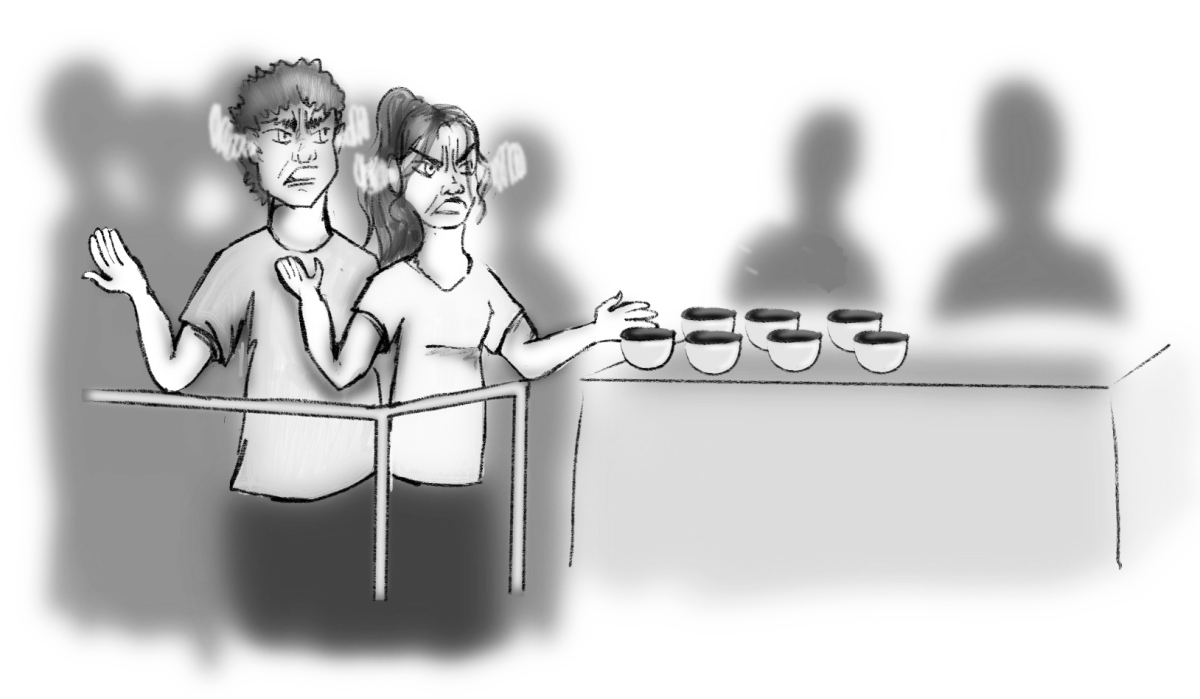
11:50. Shoot, some students are already leaving. 11:51. Ugh, I can’t concentrate. 11:52. Can we please be dismissed? 11:53. I’m going to be late. 11:54. There’s probably a line by now. 11:55. Run.
At Menlo, if you’re on time for lunch, you’re already too late to avoid the long line. Students race for a spot in the lunch line, some resorting to sneaking in with friends or wrongfully stealing food amidst the rampaging students.
It’s never that there is not enough food; after 15 minutes, anyone who wants more can come get a second bowl and additional toppings. Yet, the reality is, it takes far too long for the line to get to that point, with the last student in line having lost nearly half their lunch period just waiting for food. There have been so many times when I’ve spent 10 or even 15 minutes waiting in line instead of actually enjoying my lunch period.
Director of Dining Services Thien Hoang says that feeding around 680 Upper School students in a timely manner takes excessive planning. Often, it takes around 10 to 15 minutes for the line to finally dissipate, though it can easily be much longer on the days when students are released at the same time, such as after assemblies.
As a student, I feel beyond grateful anytime my teachers let us out even just a couple of minutes early for lunch, and Hoang fully affirms the positive impact.
“[Early dismissal] totally helps because if, […] say, two or three teachers do that, you’re getting about 150 to 200 students going through the line five minutes before all the [other] kids come,” Hoang said.
In fact, Hoang believes the best way to speed up the lunch line is by adding a slight stagger, even if only by a couple of minutes. One potential way the school could implement an official measure is by allowing students in a particular class — such as an elective — to leave just five minutes earlier on the days when class is prior to lunch. Making that change would trim the line by tons of students and save everyone a significant amount of
time waiting.
Measures need to be taken to shorten the line because it will only worsen as Menlo continues increasing class sizes. “[Menlo’s] adding probably an extra 60 students [per grade] from both [the freshman and sophomore] classes [to] the student population,” Hoang said. “And you know, as you add students, as you add to the population [without increasing] your dining space, that’s [when] you start getting into congestion.”
Many students have grown so frustrated with the line that they sneak in to get their lunch sooner. However, every time they do so, they force students behind them to wait longer.
Director of Security Mustapha Moutri is tasked with pacing the lunch line and preventing cutting. “If you’re first, you’re going to eat first; nobody should come and cut the line and go eat in front of you. That’s the whole idea; it’s just fairness [for] everybody,” Moutri said.
According to Moutri, when someone is caught cutting the lunch line, they are given a warning the first time. The second time, they are reported to Upper School Director Adam Gelb, who may task them with cleaning the cafeteria for a week.
An anonymous student who occasionally cuts the lunch line said they are either rushed or impatient. This student also suspected that at least half of the student body has cut before or does so on a regular basis. However, they said the anti-cutting measures implemented by Menlo definitely make it difficult to do so in some cases. “It has stopped many students. I would say it has stopped me from doing it really often, but there are still people who find a way to cut somehow,” they said.