
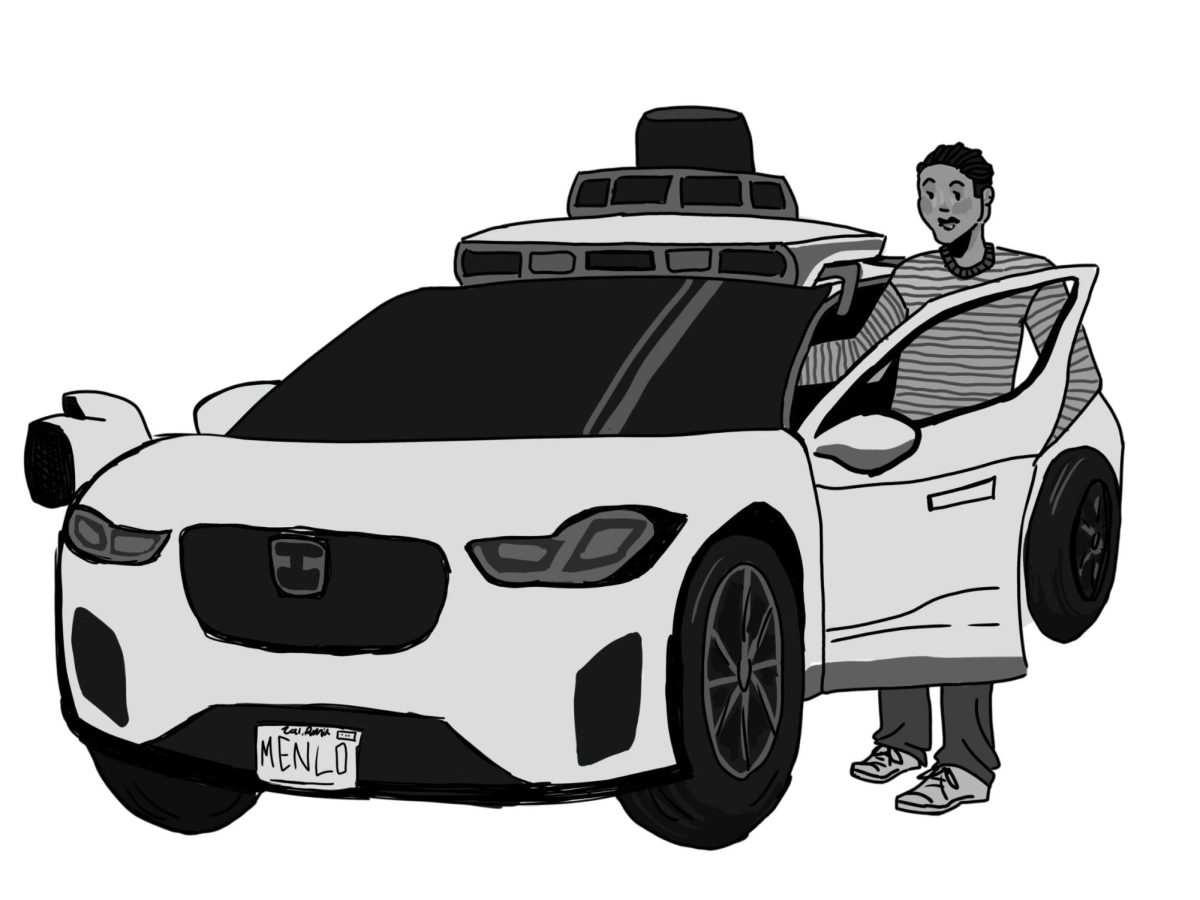
While a car with no driver behind the wheel may have been startling a few years ago, today, it’s hardly an unusual sight. Driverless cars have become increasingly common on Bay Area streets, and many Menlo students have started testing out Waymo’s autonomous robotaxi service for themselves. Waymo, a driving technology company based in Mountain View, Calif., shares a parent company with Google and focuses on developing and operating fully autonomous driving technology.
In the past year, Waymo has expanded its service zone to include the majority of the San Francisco Peninsula, covering Daly City, Brisbane, South San Francisco, San Bruno, Millbrae, Burlingame, Palo Alto, Mountain View, Los Altos and Los Altos Hills. The expansion brings the company’s self-driving vehicles closer to where the majority of Menlo students live, making riding in a Waymo significantly more accessible. Now, students are finding ways to take advantage of Waymo’s services.
For many students, the rides have been smooth and convenient. In particular, many students appreciate the privacy of being alone in the car compared to other ride-hailing services with drivers such as Uber or Lyft. Students also appreciate the vehicle’s cleanliness. Junior Teddy Shih rode a Waymo in San Francisco after taking the SAT at Lowell High School because he was interested in seeing how the experience compared to riding in an Uber. Overall, he had a good experience without any issues or delays, and he enjoyed the peace and quiet. “I didn’t really want to talk to anyone when I got in the car, so I think it’s better that there’s no person,” Shih said. Shih also appreciated that he could change the settings in the car to his liking. “I liked that I could change the music and the climate to whatever I wanted,” he said.
While some riders hesitate to trust a self-driving car, senior Munveer Singh feels the opposite. Singh first rode a Waymo in San Francisco around two years ago. Since then, he’s used them occasionally anytime he goes to the city, usually when the price is lower than an Uber. “I think Waymos are safer because the computers are better at driving than humans are,” Singh said. Singh believes autonomous vehicles will be the future of transportation. “You’re probably going to see companies like Uber and Lyft adapt their models to be more autonomous.”
Senior Amanda Wu tried taking a Waymo in Los Angeles with her parents. Her dad decided to call a Waymo because it was the cheapest option. Prices for Waymo, Uber and Lyft usually fluctuate, but they tend to stay fairly competitive with one another. One downside Wu noticed is that Waymos sometimes only drop off or pick up at limited locations. When her family visited her sister’s college campus, for example, the Waymo would only stop on a specific side of campus. However, she and her family did appreciate how the vehicle consistently drove the speed limit, making them feel safe throughout the ride.
Some students note that Waymo still struggles with the location accuracy of drop-off spots, a problem also reported by a Forbes article titled “Self-Driving Cars Are In Trouble Over Pick-Up/Drop-Off. They Can Fix It.” Senior Cole McKenney took his first Waymo ride over the summer. Although the Waymo ride was about five dollars cheaper, it dropped McKenney and his friends off three blocks away from their intended destination.
Senior Sulia Gayle tried out Waymo for the first time outside of the Bay Area, in Atlanta, another Waymo expansion hot spot. Gayle appreciated the fresh smell of the car and the peacefulness of a solo drive. “There was no creepy person talking to me, the car smelled really nice, it was just a chill drive,” she said. “It makes me feel like this is kind of the future of driving. And I like that.”
As the son of Waymo’s co-CEO Tekedra Mawakana, Waymos have become a staple in junior Kai Mawakana’s life, and he typically take them around twice a week.
Growing up alongside Waymo’s expansion, he’s learned about the ways in which Waymos are actually safer than human drivers. “Humans are naturally distracted; we all get distracted at one point or another,” he said.
Tekedra Mawakana is able to bring her experience as a parent to her work. “I relate to the challenges of busy parents, and enjoy knowing we can lighten their load by helping our kids safely get where they need to go,” she wrote in an email to The Coat of Arms. Waymo’s teen accounts give younger riders (ages 14 to 17) the ability to ride on their own across the Phoenix metro area as long as they have parental permission.
Additionally, Waymo partners with universities in the areas in which they operate, serving as the official autonomous ride-hailing partner of USC Athletics and the USC Trojans. “Sports is such a powerful way to engage with people, and we aim to expand the fan experience by getting USC fans safely, reliably and magically to and from the Coliseum on game days,” Tekedra Mawakana wrote.
Through these initiatives, Tekedra Mawakana is excited to see Waymo’s technology used by youth, like Menlo students. “It’s truly exciting for us when Waymo becomes part of [young people’s] daily lives,” she wrote.