

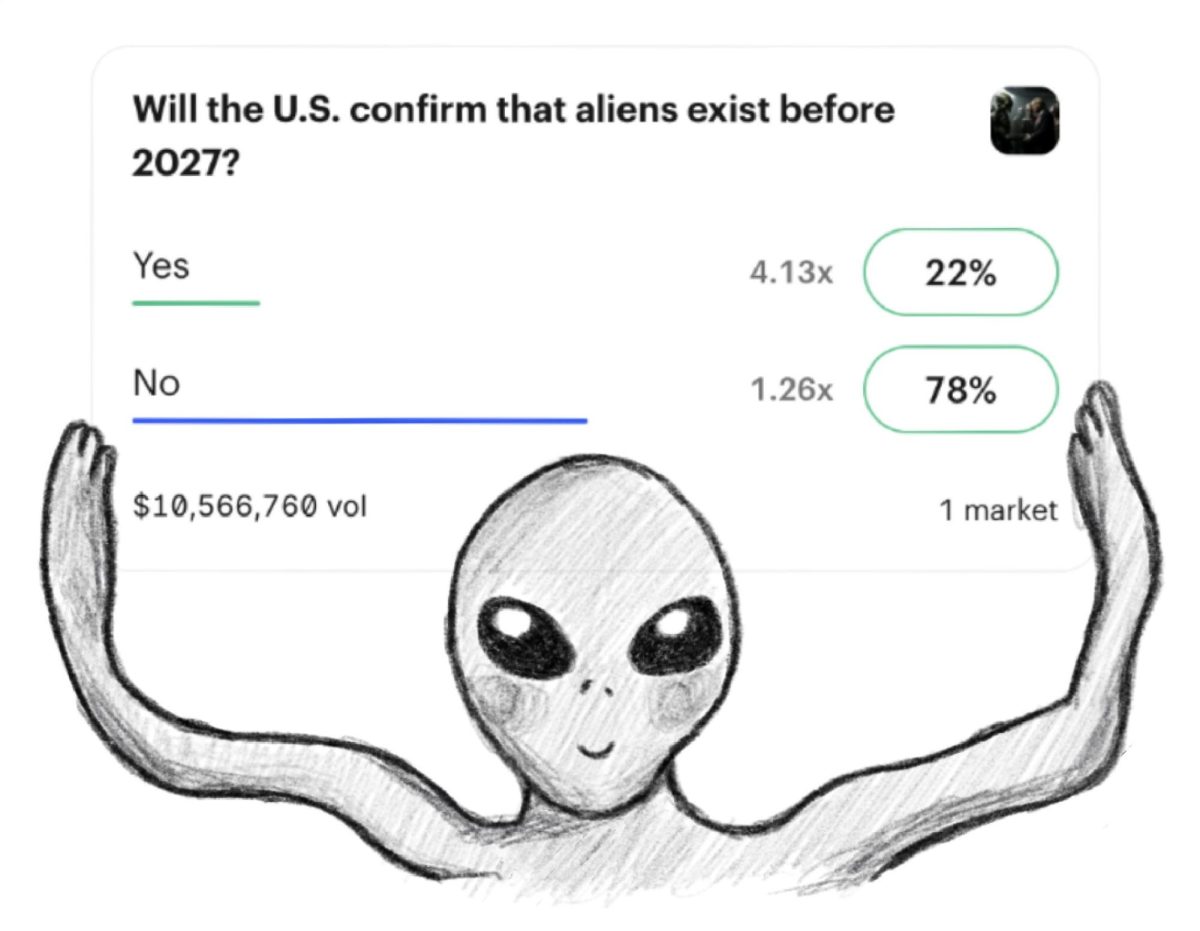
More than $37 million has been wagered on whether Jesus Christ will return before 2027. Another $13 million is riding on whether the U.S. will confirm the existence of aliens by the end of the year. And $34 million has been bet on NBA star LeBron James to win the 2028 presidential election, with another $23 million on media personality Kim Kardashian. On prediction market platforms like Kalshi and Polymarket, users are betting on just about everything.
These platforms have exploded in recent years, with the prediction market industry reaching $40 billion in trading volume. Monthly trading volume grew from under $100 million in early 2024 to over $13 billion by late 2025. Kalshi and Polymarket now control 90% of the global prediction market space.
On prediction markets, users buy and sell contracts on the outcomes of future events such as elections, sports results and weather forecasts. While traders can bet on nearly anything, roughly 90% of trading on Kalshi is sports wagers. Kalshi said it processed more than $1 billion in volume on this year’s Super Bowl alone.
In most U.S. states, the legal gambling age is 21. However, since Kalshi and Polymarket are federally regulated, they are legal in all 50 states and open to users 18 or older, raising questions about how they should
be regulated.
Critics argue that prediction markets function more like traditional gambling than the “forecasting” platforms they claim to be. Unlike casinos or sportsbooks, where bettors wager against a house with fixed odds, prediction markets operate through peer-to-peer exchanges.
Still, some policymakers and industry observers say that prediction markets should be regulated more like traditional gambling. As of late February 2026, there were roughly 20 federal lawsuits involving Kalshi alone, according to sports betting media company Action Network. At the same time, the Trump administration’s Commodity Futures Trading Commission (CFTC) has taken a more favorable stance toward prediction markets, dropping an appeal against Kalshi. Donald Trump Jr. also serves as a strategic advisor to both Polymarket and Kalshi.
Junior Darius Landsdorf downloaded Kalshi in January after seeing several ads on Instagram. “When I downloaded it, I was overwhelmed by how many options there were for things to bet on,” Landsdorf said. “I could bet on anything from the weather in Chicago to sports games to when World War III will start.”
Landsdorf first became interested in sports betting, particularly on the NFL and NBA. “I was honestly surprised to find that [Kalshi] has sports betting on it, because I thought that would just be classified as a sportsbook and casino gambling,” he said.
Landsdorf soon branched out into more unconventional markets. “As I was spending more time on the app, I was looking at more niche betting options like whether the U.S. will declare aliens exist this year and when Jesus will return — all sorts of crazy things like that,” he said.
Landsdorf also said he was surprised by how easy it is to use the platform. “I do find it a little concerning how accessible it is and how there’s almost no background checks or anything,” he said.
Despite the range of options, Landsdorf advises users to approach these markets strategically. “Stick to your areas of expertise and don’t get into any weird stuff that you don’t know about. If you know a lot about basketball, bet on basketball,” he said.
At Menlo, Landsdorf said only a few of his friends use prediction markets. However, he noted that it’s common for students to gather and decide what bets to place as a group.
Senior Jacob Elkes has been on Kalshi since early December and said he’s only placed a few small bets on things like sports games, but estimates that he’s up roughly $20 in total.
Like Landsdorf, Elkes remains skeptical of how prediction markets operate. “I do not think there’s a difference between prediction markets and gambling. The real difference that I see right now is the difference in regulation,” Elkes said. “Sports gambling, and gambling in general, is regulated
so heavily; meanwhile, prediction markets, they’re just not regulated at all.”
Elkes said that he first became interested in prediction markets after hearing about people making huge profits from insider trading. “Anytime someone has a decent amount of information on a big topic, a huge amount of money on Kalshi or Polymarket will be moved at a given time, and then a lot of money will be made off that,” he said.
According to The New York Times, at least 16 Polymarket accounts that placed bets predicting the U.S. would strike Iran by Feb. 28 ultimately made more than $100,000 each. At least 109 accounts made more than $10,000. One anonymous user who spent more than $60,000 on “yes” shares in the days before the attack made nearly half a million dollars.
“There’s two kinds of people going on [prediction markets],” Elkes said. “The inside traders and the people that are desperate gamblers.”
Elkes, however, isn’t so sure prediction markets, in their current state, will stick around. “I think they’ll be regulated,” he said. “And I think it’s a good thing for them to be regulated because people are getting scammed out here for their money because [other] people have insider info.”
Landsdorf on the other hand, is more optimistic about prediction markets. “They’re definitely going to stick around,” he said. “I don’t know about the sports betting aspect of it, but everything else I feel like will stay, especially since it’s already a billion dollar industry.”