

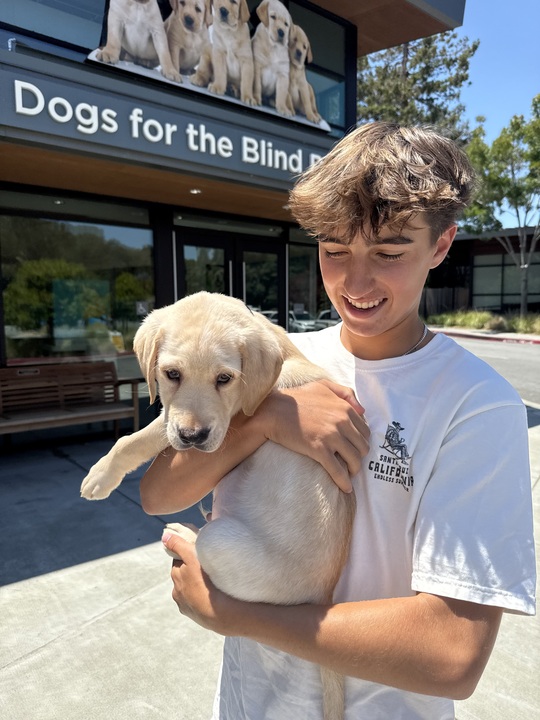
If you see a yellow labrador trotting around campus with its vest on, odds are it’s Dewey, sophomore Jacob Marks’ guide dog-in-training. While it can be tempting to play with him, it’s important to let him roam and learn when his training vest is on.
Animals have always been a significant part of Marks’ life and his family’s lifestyle. He has had 10 pets in his lifetime, ranging from bunnies to guide dogs-in-training — Marks’ latest adventure.
Marks started working with an organization called Guide Dogs for the Blind this year, a group focused on harnessing the power of dogs to transform the lives of people with visual impairments. While their main campus is in San Rafael, Marks works with the Palo Alto club.
In June, Marks took on a puppy named Dewey to train. “When I got him, [Dewey] was just a bare bones puppy,” he said. “He’s a much better dog now.” Marks will spend a total of 15 months with Dewey, which started in June and will end in late 2026. “I’m really just training him [to have] good habits and to be a good dog,” Marks said. “He has to be able to be calm in distracting environments.”
Marks watched his sister, Alea Marks ‘23, go through the same program while she was in high school at Menlo and was inspired to do the same. “I learned how I would be truly impacting someone’s life,” Marks said. “I met the woman who her dog went to guide, and it was super rewarding.”
Marks’ family has always been a big animal household. Marks says training Dewey is a way for him to make a difference in a field that is very important to him. “It’s really valuable to be able to possibly affect someone’s life in that big [of] a way,” Marks said.
The organization is a nonprofit dedicated to pairing guide dogs with individuals who have impaired vision. They breed labrador retrievers and golden retrievers. Marks’ job is to train his dog to eventually become a service dog for someone who needs assistance navigating daily life.
The program has participants from ages nine to 90. After this period, the dog will return to the organization’s campus in San Rafael for formal training, after which it can be matched with an individual.
Marks isn’t sure what the future holds for him in regards to guide dog training. “I do think it would be a lot of fun to do again,” Marks said. “But it’s such a big responsibility and it does take up a lot of my time.” If Dewey doesn’t go through formal training, he would become Marks’ pet, an outcome Marks would be happy with. “[But] if Dewey does fail, then he will become my pet dog, and I don’t know if I want to have that many dogs around the house [if I start training another],” Marks said.
Training Dewey is extremely gratifying for Marks, and he would encourage others to go through the same process. Dewey sometimes comes to Menlo and can be out on the quad. Allowing him the space to learn and work is a vital part of the process.