
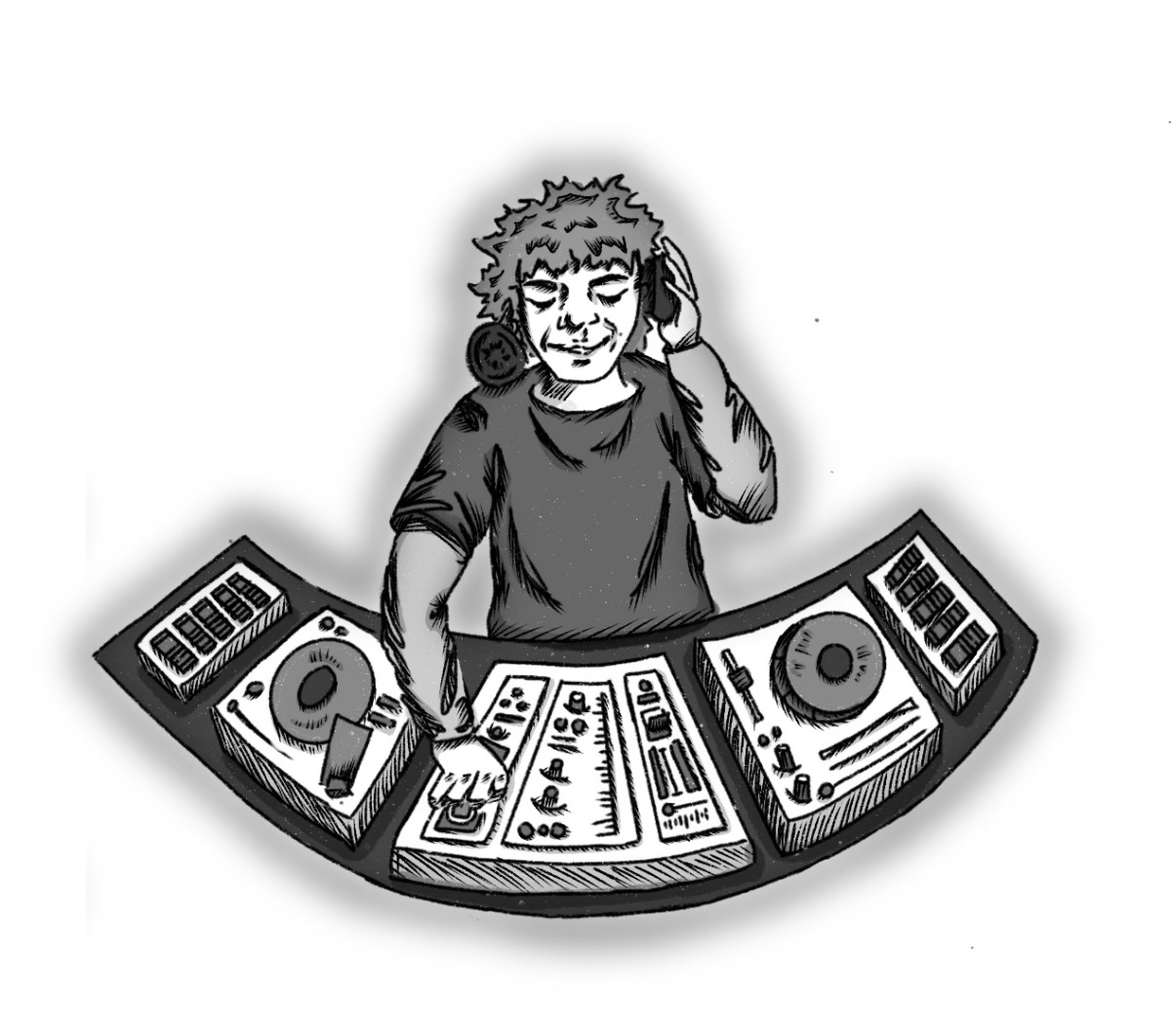
It’s homecoming, and you are bouncing up and down to the music blasting out of the speakers. You look up at the DJ table to see who is spinning this fire set. Wicka wicka what? Is that a Menlo student behind the table?
Last homecoming, senior Arki Temsamani was given the opportunity to DJ part of the dance, which he said was an amazing experience. “It’s always nerve-racking because you don’t want to make a mistake in front of everyone, but we put a lot of time and effort into preparing, and it felt like people enjoyed it,” Temsamani said.
Since its debut in the 80s, the electronic dance music genre (also known as EDM) has been on the rise. Recently, it’s become a post-pandemic craze and a newfound passion for younger generations, with DJs like Australian producer Fischer selling out massive concerts.
Free DJ apps (digital audio workstations) allow anyone with a device to experiment with pre-made loops, audio and virtual instruments. One of these apps, Apple’s GarageBand, is where sophomore Rex Labatt learned how to mix beats after watching some of his friends experiment with it. “I think it’s really fun to be able to control the music,” Labatt said.
Moreover, Labatt and two other sophomores — Deven Dholakia and Evan Grant — have expanded their tunes beyond their computer speakers and found some success DJing in public places. Through their joint DJing account on Instagram, “devex.music,” the group has received some gig opportunities in downtown Palo Alto and continues to post when and where they will be DJing next. “[The account] is really fun because we all equally love the activity,” Labatt said.
For those who prefer a more advanced way to scratch and blend, Menlo offers a music producing elective called Push Play, which uses more technologically advanced materials than those you might find on a laptop or phone. Because students wanted to expand their skills past the keyboard after the pandemic, instrumental music teacher Leo Kitajima Geefay introduced the semester-long art class in response to the craze. The class uses Akai Professional MPCs, a special type of sampling sequencer introduced in 1988, that allows students to create new beats and experiment with different types of music using the machine’s intricate modes and velocity sensors.
“It is cool to see so many people now realizing that you don’t have to be a formally trained musician to be able to join the music making community,” Kitjima Geefay said.
Kitajima Geefay said the free-spirited nature of the hobby allows novice DJs to express themselves through the music, just like one might while painting or singing. “I consider that to be an art because you’re not just playing a certain song. You’re kind of creating things as you go,” Temsamani said.
Temsamani first got into DJing because his mom felt it might be a way for him to channel some of his energy into a useful and creative skill. After his mom gifted him his first DJ board, the visions became a reality. Now, Temsamani feels that he can even have a future in DJing due to his love for the activity. “I want to start getting into producing my own music, so if I ever do that, there is definitely a future,” Temsamani said.