

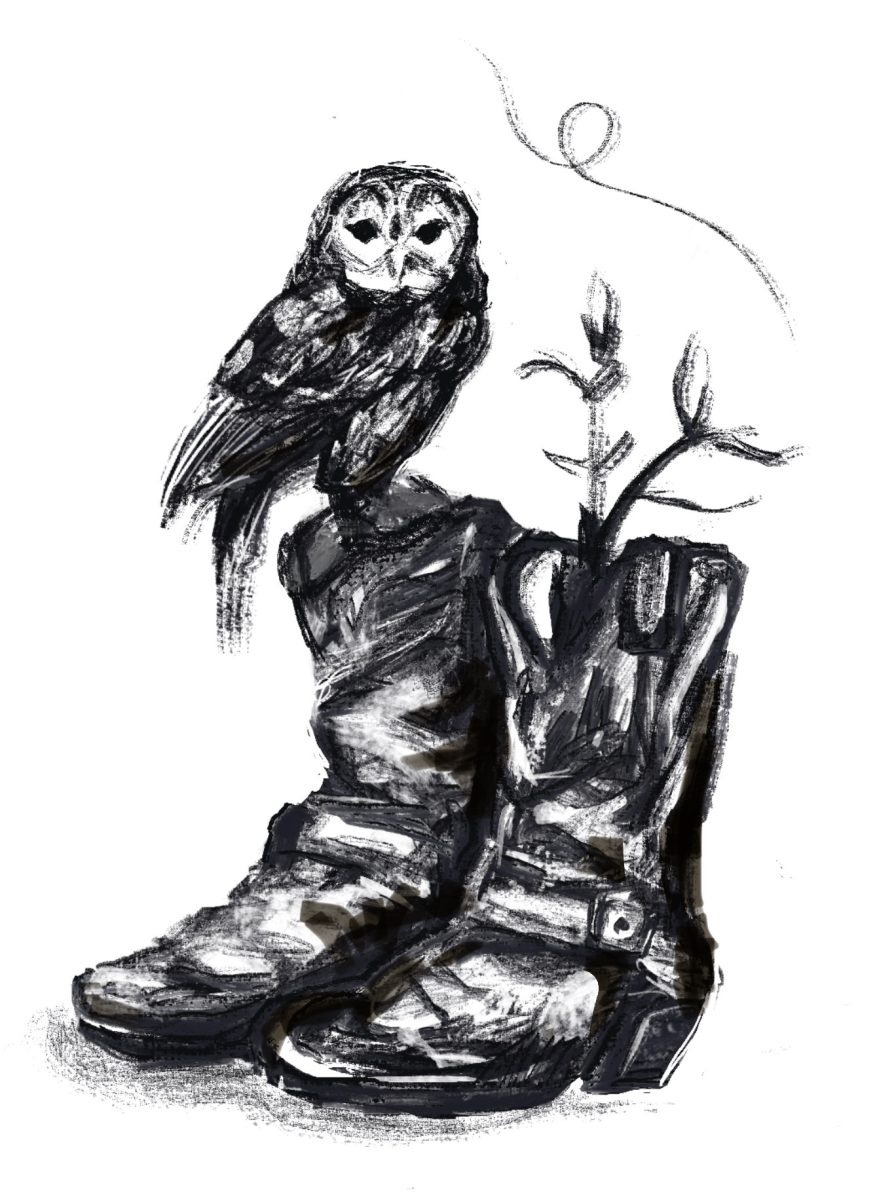
The stereotypical image of the wilderness clouds the minds of many Americans: untouched forests and breathtaking landscapes. However, the Literature of the American Wilderness class, taught by English teacher Whitney Newton, encourages students to view wilderness not as distant or untouched, but as something humans are deeply intertwined with. The fall semester senior honors English elective traces the evolution of the American understanding of our relationship with nature. Through literature, history and art, students examine how American attitudes toward the wilderness have shifted over time, changing their perception of the natural world.
Newton was first introduced to the subject while working as a teaching assistant at the University of Michigan for a course with the same name, but initially, she was unsure about the concept. “I did not see myself as a very crunchy person. I was definitely still living in my cerebral landscape,” she said.
The course, however, quickly changed her perspective, helping her connect with nature after feeling disconnected from it for years. “What is cool about this class is it got me back into nature, which I was connected with as a kid, but then wasn’t when I was an adult for some reason,” Newton said.
Inspired by the experience, Newton decided she wanted to teach a similar class when she began working at Menlo. Some of the readings students discuss in the class today are drawn directly from the original syllabus, though Newton has spent years adapting and expanding the course, making it her own. She taught the class for five years when she first arrived at Menlo in 2012 before temporarily retiring it.
This year marks the course’s second year since its return. “That class [at Michigan] catalyzed a part of my identity that I needed to have turned on,” she said. “Now […] I [hope to] catalyze that for students.”
The course has six units that trace how Americans’ relationship with nature has evolved throughout history. Students dive into the cultural tensions between wilderness as a site of survival versus leisure, the creation and consequence of public lands and the growth of environmental consciousness in the mid-20th century.
Senior Hanna Yu said the variation in assignments was one of the most engaging aspects of the class. “We had to write a letter to our future kids about a sustainability ethic, analyze a series of paintings by Thomas Cole, and […] I also wrote an essay on Beyonce’s Cowboy Carter album,” she said.
While Newton enjoys all of the units, she particularly enjoys teaching about the Frontier Myth and Cowboy Mythology. “I feel like that one’s fun for the students,” she said. “But for me, the joy is just like watching the pieces fit together and build on each other over time.”
Senior and Co-Leader of Climate Coalition Tess Vogel really enjoyed the class. “It was very discussion-based, which I liked a lot,” she said. “Everybody was just very into the material, which made it super fun to come to class.”
Newton believes constricting ideas about what an environmentalist should look like or how they should act leaves people out. “When people say, ‘I’m not an environmentalist,’ I’m like, ‘what do you mean?’” Newton said. “‘You live on this planet.’”
By the end of the semester, Newton hopes students walk away with a more nuanced understanding of environmentalism. “I hope that everyone walks out feeling like ‘I have a stake in this planet, and what happens to it matters to me and […] I am part of this instead of separate,’” she said.
Yu found that the class also challenged her to reconsider the idea of wilderness as something separate from herself. “Previously, I thought of wilderness more as ‘other’ and ‘a different space,’” she said. “But I’ve since learned that […] we impact the environment around us on so many different levels through our everyday choices.”